A is for...The Angel of Mercy

Updated: Feb 2, 2023
Bertha Gifford AKA "The Angel of Mercy"
Bertha Gifford, a volunteer nurse poisoned 18 people, mostly including children with arsenic.
If you hate to use your eyes and prefer to use your ears, listen to this week's episode by clicking the link below! Otherwise, if you love to stare shockingly at the computer screen while at work continue on my fellow readers…
Born as Bertha Alice Williams in 1874 in Morse Mill, Missouri. She was the daughter of William Poindexter Williams and his wife Matilda. Bertha was one of ten children, two had died in infancy leaving six boys and two girls.
Bertha married Henry Graham in 1894 at age twenty-two and this union produced one daughter, Lila. The two owned a small boarding house together. At five feet, two inches, petite in her youth with auburn hair, blue eyes, and tan skin she was considered the most beautiful woman in her town. Bertha and Henry lived a quiet farm life - that is until Eugene Gifford came to town.
Eugene (Gene) was in his 20s (and engaged) and Bertha, a married woman in her thirties. Rumors had been spreading like wildfire in Morse Mill of Henry's infidelity. As a result, Bertha began to see Gene openly and more often. She cared little about what people thought about the affair and it eventually lead to a quarrel with her husband. Months later Henry was ill with pneumonia and died shortly after from server stomach cramps. Bertha collected the insurance for her husband's death and the widow married Gene (who broke off his engagement) less than a year later in 1907. The couple moved to Catawissa with Lila (Bertha's daughter) and had one child, James.
Betha was known by her community for being an extraordinary cook and caring for the sick. Due to the rural nature of the town, it was very difficult to get medical aid in cases of emergencies. Bertha would make her own concoctions to help aid muscle aches, pains, and other ailments for the sick people in her town.

In 1911, Emily Gifford, Eugene's widowed mother, and younger brother James move in with the couple. in 1913 Emily becomes ill with stomach cramps and vomiting and eventually dies. A year later, James, 13, died in Bertha's arms from similar symptoms.
In 1915, Bertha's close neighbors Mr. and Mrs. Stuhlfelder's 15-month-old son, Bernard, grew ill with pneumonia. Bertha jumped at the chance to care for the sick child. That night, under the care of Bertha, the child began to vomit and continued to vomit for four days until he died. In 1921, Margret Stuhlfelder, two and a half years old, fell ill with pneumonia. Not long after Bertha's arrival Margret began vomiting and died three days later. Irene the oldest child, 7, had been plagued with stomach problems too. Dr. Hemker (a doctor who had been practicing medicine in the town for twenty-six years) prescribed medicine to the child and she began to improve. Then Bertha came by. Hours later Irene began to vomit and died nine days later (Murphy, 2021).


In 1917 a hired hand for the Gifford's ranch, died in Bertha's care. James Louis Ogle had been seen by Dr. Hemker and was being treated for malaria. James developed gastritis and the doctor assumed it to be a symptom of malaria. No autopsy was performed following his death, it was assumed to be a complication from malaria.
In 1922, Sherman Pounds, a neighbor and relative of the Gifford's came over one day for a visit and a meal. Shortly after dying of stomach cramps. When young, three-year-old Beulah Pounds became ill, Bertha threw on her nurse uniform and jumped at the chance to care for the child. The same fate as Sherman Pounds and all the others happened to poor Beulah Pounds.
There was quite a stir in the town about the Gifford's place being “The House of Mystery” and rumors of “something queer” going on in that house caused a sense of fear from those who came in contact with Bertha. Many towns folk felt Bertha was not to be trusted. Many neighbors questioned the integrity of Bertha’s care.
Eva Ramsey wrote a letter to the sheriff about her encounter with Bertha. She stated that, in 1925, Eva Ramsey's daughter Mary Elizabeth Brinley had been released from the hospital after surgery for a spinal infection and was taken to her grandmother in Catawissa for her recovery. Upon arriving home to see her daughter, Eva Ramsey's sister saw Bertha bending over the seven-year-old's bed with a little medicine box in her hand. When Eva's sister spoke to Bertha, she would quickly put the box in her apron and scurry away. The young child died the next day.
Mary's father, Caswell Brinley had also had Bertha "sit up" with him after his car accident. He was severely injured and was taken first to a relative's home. Bertha received news of the accident and rode several miles on horseback to be by his bedside. He was taken to the hospital the next morning and died seven days later (Murphy, 2021). Again, no autopsy was performed and Dr. Hemker wrote it off as gastritis.

Gene made his money by leasing out farms. He had cows, hogs, and mules and grew corn. In 1926, Gene was found guilty of violating the "bone dry law" which banned the sale and consumption of alcohol. He was ordered to pay a fine of five hundred dollars. Gene's criminal record did not diminish his reputation in the eyes of the community, he was well-liked and well-respected. In fact, the town's people felt sorry for Gene and the scandal with Bertha. In the same year, George Schamel brought his sons Llyod, 8, and Elmer John, 7, to the Giffords. George had lost his wife and was having a tough time raising the boys. Bertha so graciously opened her home to him and his sons. Lloyd became ill with stomach pains shortly after their arrival and died two days later.
In the spring of 1927, Edward Brinley, 48, died at the Giffords home. A former butcher who lost his job often came to the Giffords to help with odd jobs. He showed up drunk to the Gifford's house, falling on the front porch. Bertha tended to Edward that night and he died the following day.
The doctor who signed off on the death certificates of each of the cases was Dr. W. H. Hemker, stating the cause of death as "unknown - acute gastritis and toxic condition." No postmortems were ever done until Ed Brinley died. Edward Brinley‘s widow Ludelphia insisted the chief of police investigate her husband's death further. Bertha was then questioned and ultimately indicted for the murder of Edward Brinley.
Dr. Hemker had become suspicious, even before the death of Ed Brinley. A familiar pattern had emerged that he could no longer overlook. Brinley’s symptoms were similar to those of the other cases, becoming suddenly sick and then dying under Bertha's care. Dr. Hemker consulted his colleagues, the other doctors could not agree on whether Brinley had been intentionally poisoned. So Dr. Hemker signed off on Edward Brinley's death certificate as gastritis. No further investigations about his suspicions were continued. Though he could have insisted on an autopsy in each case, but he never did. The press began to question the doctor's rationale, and he claimed he did not want to be sued for libel if he was wrong.
Meanwhile, Ludelphia Brinley finally succeeded in getting a prosecuting attorney, Frank Jenny, to investigate the death of her husband Edward Brinley, a grand jury convened and listened to the testimony from several witnesses including relatives of Brinley, relatives of Pounds, George Schamel, and Dr. Hemker.


Immediately, Bertha Gifford threatened liable suits against any neighbors, who testified and against any newspapers that would report on the hearing. The investigation had been called off - or 'scared off,' is how it was characterized in the press. "Bertha Gifford was a 54-year-old, gray-haired woman who stood only five feet, two inches tall, but apparently was quite intimidating to her community" (Murphy, 2021).
Bertha was arrested on August 25, 1928, for the murder of Edward Brinley. She was also suspected of having been involved in the death of at least four others. They were: Sherman pounds, Beulah Pounds (3), Lloyd Schamel (8) and Elmer Schamel (7). Baffled and confused by the accusations of murder Bertha went calmly and without resistance. There was little evidence and no motive for the murders, the case against Bertha was very weak in the eyes of the law. After being taken to the station for questioning, Bertha made a written statement, stating she put arsenic in the medicine before giving it to Lloyd. She also describes the day Edward Brinley drove up to their house drunk and fell on their front porch. She says her husband brought him inside and fixed him up for bed in the front room. Edward’s mother came over and insisted they call the doctor. Dr. Hemker came by leaving medicine for Edward and Bertha admitted to putting arsenic in the medicine. Bertha goes on to explain, in all three cases (Edward, Lloyd and Elmer) the patients were suffering from severe pain in the stomach, and she put arsenic in the medicine "to quiet their pains" (Murphy, 2021). The officer forwarded Bertha’s statement to the press and the newspaper headlined it as Bertha's "confession" of murder.
A second grand jury investigation was called eight months after the first one when more sentiment against her grew and pressure on the authorities to investigate continued, until they finally gave in. Several people came out of silence to testify in front of the grand jury about the sickbed deaths under Bertha's care. George Stuhlfelder's mother, Mary, fell ill one day and had been sick for a week. Naturally, he called on Dr. Hemker. Mary began to recover, telling her son she felt better. Bertha stopped by for a visit to check on the sick elderly lady. Bertha "ushered George's brother and son out of the room telling them she had to give Mary her medicine." Within moments of administering Mary's "medicine," Mary complained about stomach cramps. She lost consciousness and died the next morning. Not only did George's three children and mother die under Bertha's care but his sister Leona Slocum died a month after her nephews.
Another testimony came forward with the mention of the name "Grandma" Birdie Unnerstall. Birdie and her son Gus were neighbors of the Giffords. One visit from Bertha led to the terrible death of Birdie. She died of similar symptoms to those before her.
Police later had reason to exhume the bodies of Edward Brinley, Llyod and Elmer Schamel and found large amounts of arsenic in the liver and kidneys, concluding their cause of death was in fact poisoning. Attorney, Frank Jenny, found correlations between the deaths and the signatures of Bertha Gifford in the logbooks of two separate drug stores with the purchase of arsenic. Bertha had claimed she was "buying the poison to get rid of her barn rats." Each time someone died not long after (Murphy, 2021).
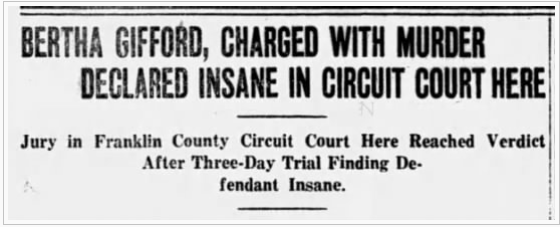
Bertha was charged with the last three deaths and was tried only in the case of Ed Brinley. In November 1928, a Franklin County Circuit Court jury found her guilty by reason of insanity and was committed to the State Hospital at Farmington the following month. She lived 23 years in that asylum and died in 1951 (Wood, 2016).
"Although infamous for its toxicity, arsenic is paradoxically a therapeutic agent that has been used since ancient times for the treatment of multiple diseases. The use of most arsenic-based drugs was abandoned with the discovery of antibiotics in the 1940s" (Paul, et al., 2022). Arsenic was used as a treatment for syphilis, diabetes, psoriasis, and skin ulcers during Bertha's time. So, it was not uncommon for one to prescribe or take Arsenic. During her questioning with the police, Bertha stated she would take small bits of arsenic to keep her looking youthful.
A few things pointed out by S. Kay Murphy (Bertha's great-granddaughter) in her novel "The Tainted Legacy of Bertha Gifford: A Memoir" during the trial of Bertha Gifford seem slightly suspicious and possibly inconsistent. If found guilty, Bertha would be hung for murder.
Bertha's attorneys' original plea was changed in the middle of the trial because they believed the jury would swing on the plaintiff's side. This would mean Bertha had a date with the noose. They change her plea to guilty by reasons of insanity to save her life.
The attorneys never had Bertha take the stand, which Murphy points out as being odd because wouldn't you, as an attorney, want to prove the courtroom client is insane? Murphy also points out, from Bertha's written statement with the sheriff on August 25th she was sound of mind, answered questions clearly, was entirely coherent, and showed no signs of paranoia.
Some of the physicians (not even psychiatrists) testified stating Bertha suffered from 'dementia praecox' without even examining her or speaking with her. Some even stated, "She is unquestionably of unsound mind, suffering from chronic paranoia, incurable."
The psychiatrists brought up her "delusions" in order to explain her motivation for murder without any substantial evidence.
Gene, who insisted on Bertha's innocence the whole time was now testifying to Bertha's "altered state of mind." An obvious ploy to avoid hanging. The newspapers stated Bertha had shown no emotion whatsoever during this trial, but when Gene took the stand she giggled and covered her mouth. A peculiar reaction and the news reporters noticed.
When she was convicted for the poison murders she said, "but I wanted to help them. I wanted to be good." Each one of Bertha's victims had some sort of issue in their life Bertha believed to have caused suffering and believed she was the only one to rid them of the suffering. Ed Brindley was an alcoholic who had no job and couldn't care for his wife or kids. Ed's murder left his wife a good sum of money for his life insurance. The death of the Schamel boys was because they had no mother to care for them. Instead of helping the "sick" recover, Bertha believed it was best to just put them out of their misery.
Murphy had also dug up some of her great-grandmother's records from her stay at the State Hospital at Farmington. The files stated Bertha "continues to be a good worker and nice quiet patient." She noted that out of forty-five lines that documented Bertha's stay there was "no mention of any psychiatric evaluation or treatment after the first year." Bertha worked in the hospital’s beauty salon and later became one of the cooks. She was also allowed to leave the facility and go home from time to time.
Several years after Bertha’s death, in 1981, a journalist by the name of Joe Popper, wrote an article on Bertha stating the effects of arsenic when consumed in large quantities can cause, “severe gastrointestinal pain is experienced within an hour or so after the poison is taken. This is generally followed by a burning sensation around the lips, a tightening of the throat, and increasing difficulty in swallowing. The next symptom is excruciating pain accompanied by spasmodic vomiting. Other symptoms include severe headache, vertigo, stupor, blurring of vision, muscle cramping, atrophy, and coma. Death may come within 60 minutes, but usually takes longer.” Sounds like the victims of Bertha were given more than a "little" dose to help with aches and pains.
A total of seventeen deaths under Bertha's "care", eighteen if you count the possible poisoning of her first husband was tallied. Did Bertha commit these murders in an attempt to play God? Or was she truly naive in using this "medicine" to rid her loved ones of pain? I guess Bertha is the only one who will ever know...
If you'd like to listen to this episode click the link below!
Disclaimer: by creating this blog & podcast on this topic, I am covering facts I have believed to be the most reliable from conducting my own research. If there are any details that are missing or inconsistent between this blog or podcast and the real case please feel free to leave a comment with any suggested edits. See the references below for more information.
REFERENCES
“Bertha Gifford: Great Poisoner or Awful Healer? | Cabernet & True Crime E:48.” YouTube, YouTube, 17 June 2022, https://www.youtube.com/watch?v=kMYzzL9nXRY. Accessed 5 Jan. 2023.
Blanco, Juan Ignacio. “Bertha Gifford: Murderpedia, the Encyclopedia of Murderers.” Bertha Gifford | Murderpedia, the Encyclopedia of Murderers, https://murderpedia.org/female.G/g/gifford-bertha.htm.
Cernich, Karen. “A True Franklin County Horror Story.” The Missourian, 24 October 2005, https://www.emissourian.com/features_people/a-true-franklin-county-horror-story/article_3ef129cc-8bf8-506b-a8b3-8d8600e5ef2d.html.
Murphy, S. Kay. The Tainted Legacy of Bertha Gifford: A Memoir. 2021.
Paul, Ngozi P., et al. “Arsenic in Medicine: Past, Present and Future.” BioMetals, 21 Feb. 2022, https://doi.org/10.1007/s10534-022-00371-y.
Wood, Larry. “It's All in the Past: Serial Killer Bertha Gifford.” The Worcester Telegram & Gazette, The Rolla Daily News, 4 May 2016, https://www.telegram.com/story/opinion/columns/2016/05/04/it-s-all-in-past/30983275007/.


Comments